Last August, I wrote a bit about my grumpy-old-man syndrome regarding changing standards in what's considered "acceptable" basing techniques. Since then, if anything, I've gotten even grumpier about the topic.
This is largely due to me dipping a toe into a couple of the skirmish-scale fantasy games that are currently enjoying a wave of popularity, namely Warmachine/Hordes and Malifaux. Both games seem to exemplify the extremes of "diorama" basing that is so trendy these days.
Now, I certainly don't shy away from tarting up my bases a bit with some static grass and a flowering shrub or two, but some of the stuff I've seen (particularly for Malifaux) has been pretty extreme. I mean, when your base is as big as the figure that stands atop it...I'm just not sure what that's supposed to accomplish.
The thing is that, for me, I look at a wargaming miniature as a smaller component of an overall whole. All the miniatures on the table should, ideally, complement the scenic layout (and vice versa) such that, when you're looking at the whole panoply, it should seem almost like an organic diorama in its own right. I've made no bones in the past about my aesthetic snobbery when it comes to minis gaming, and this is simply part of that overall philosophy: that I play miniatures games as much for the visual appeal as for the tactical challenges it presents.
In fact, I really don't have any objective objections (heh) to overly-elaborate basing in its own right. If these fancy bases were simply being used to further a goal of painting one's miniatures purely as display pieces, then going nuts with the basing makes perfect sense. It's only once those same figures are placed on a gaming table that I cock a Spock-like eyebrow of judgment.
The thing to consider here is that my emphasis on aesthetics does sometimes border on the neurotic. As I wrote about in the above-linked post, I miss the days of simpler basing in part because today's standards add a lot more work per figure, and I'm lazy. But I'm also a bit down on today's more elaborate bases because - and I'm somewhat embarrassed to admit this - there's a part of me that inwardly winces when, say, a miniature with a classic "grassy turf" base moves into an area of the table with a noticeably different type of ground surface, like a watery marsh or cobblestone street.
Enter transparent plastic bases...
I've been particularly arrested by the increasingly frequent use of these guys as a method of basing. This seems to be the polar opposite of the elaborate base, both in terms of work and aesthetics: a base that you literally do nothing to other than affixing the figure, and a base that, by definition, matches whatever terrain the figure is standing on.
Looking at those points, transparent bases would seem to be ideal for my tastes. Yet I don't want to abandon scenic bases entirely. They still have their place, aesthetically.
But I'm definitely going to base my Malifaux figures on clear bases as a sort of test case - see how they look in person, and how they look on the game table. Plus, and this is just the contrarian in me, I love the idea of going hyper-minimalist with figures for a game that features so many overwrought bases.
Wednesday, March 05, 2014
Tuesday, January 28, 2014
A Wonderful Blast from the Past
Following a trail of links, this morning I found myself inspired by a set of photos of an old-school fantasy army made up of vintage Minifigs and Citadel sculpts, and paint jobs inspired by King Crimson's In the Court of the Crimson King.
When it comes to miniatures, I absolutely eat this stuff up. This sort of whacked-out imagery evokes memories from my childhood of strange books and movies, imagery that made me fall in love with all things fantastic. It brings to mind Brian Froud and Alan Lee and Terry Gilliam and innumerable other creative visionaries. It reminds me of a time when all fantasy wasn't necessarily grimdark and serious and codified.
Check out the full photoset here and bask in the trippy glory!
![]() |
| Love the pine bark armor and pine cone standard! |
![]() |
| You really can't go wrong with animated hands, especially giant ones. |
![]() |
| There need to be more saturated pastels in today's painter's palette. |
Check out the full photoset here and bask in the trippy glory!
Saturday, December 28, 2013
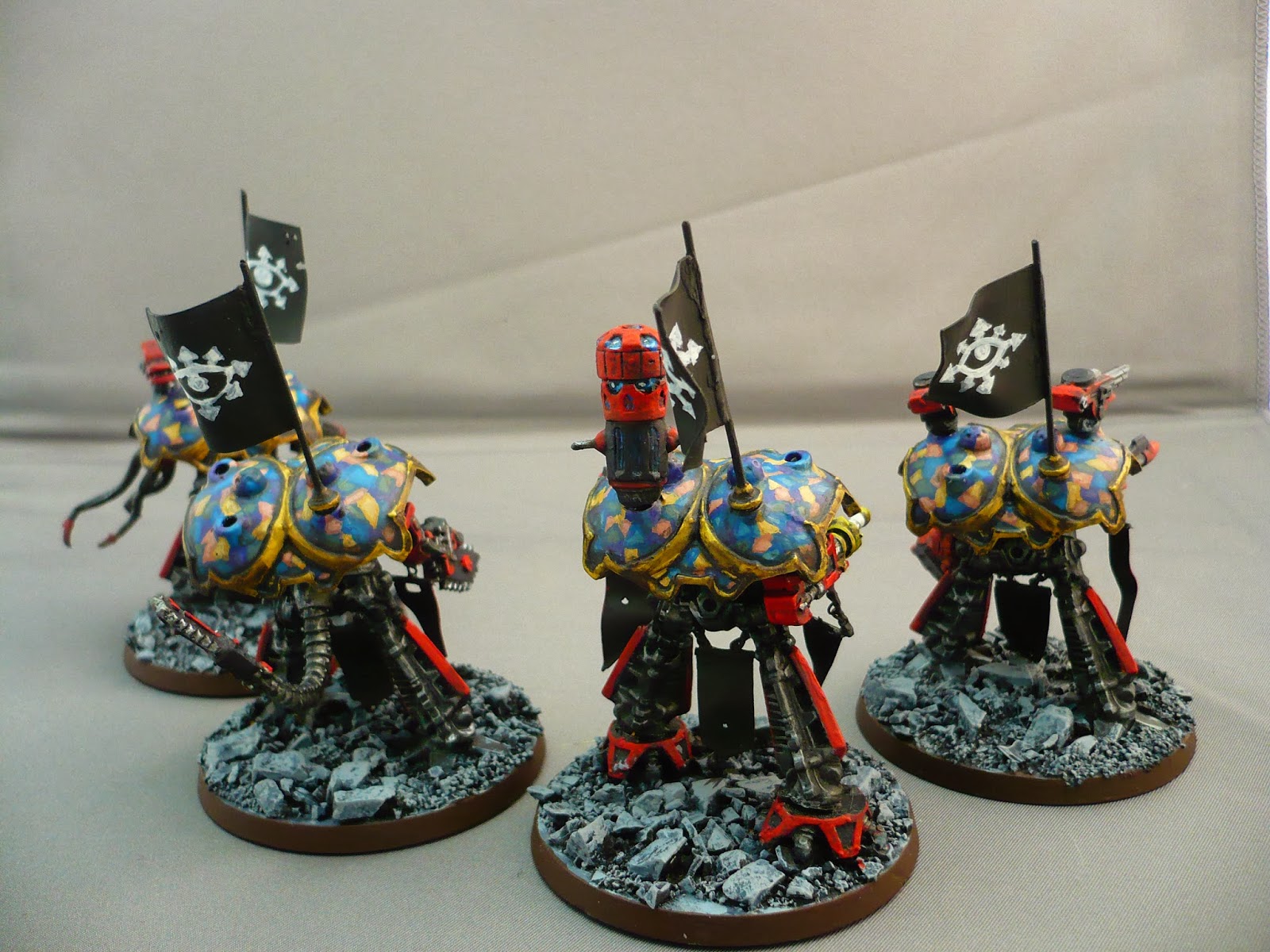
[Epic] Traitor Titans of the Legio Mortis
I actually completed these guys a few weeks ago, but only just got around to taking photos of them.
These are the first of the Warlord Titans I picked up through eBay earlier this year. I've painted them up for use with Adeptus Titanicus as members of the traitor titan legion of Legio Mortis. In due time, these will become Chaos Titans of Nurgle, but in the AT continuity they are still more or less closer to their human roots. Nevertheless, I loaded these guys up with as many chaos-like weapons as I could lay my hands on.
My goal in painting these was to give them as much detail and care as I wished I could have when I painted my first Warlords as a young lad. Back then I wanted very much to do a full complement of banners, flags, and pennants, as well as scale-appropriate paint jobs, and I'm quite pleased with how I was able to realize those goals. I found a fun way of making sturdy banners by using plastic from blister packs and a bit of heat from a candle flame to shape the plastic into billowing forms. I used jewelry chain to hang the banners, as suggested in the AT rulebook - it looks great, although it's a bit flimsy and I anticipate much breakage and repair in future games. Ah well. The disruption pattern (modeled on World War I German designs) sported by the Legio Mortis, as nice as it turned out, nearly proved my undoing.
My next project in my Epic collection will be to paint up four more Warlords from the loyalist Legio Metalica. Fortunately, those guys don't sport disruption patterns on their carapace, so things should go a bit faster.
These are the first of the Warlord Titans I picked up through eBay earlier this year. I've painted them up for use with Adeptus Titanicus as members of the traitor titan legion of Legio Mortis. In due time, these will become Chaos Titans of Nurgle, but in the AT continuity they are still more or less closer to their human roots. Nevertheless, I loaded these guys up with as many chaos-like weapons as I could lay my hands on.
My goal in painting these was to give them as much detail and care as I wished I could have when I painted my first Warlords as a young lad. Back then I wanted very much to do a full complement of banners, flags, and pennants, as well as scale-appropriate paint jobs, and I'm quite pleased with how I was able to realize those goals. I found a fun way of making sturdy banners by using plastic from blister packs and a bit of heat from a candle flame to shape the plastic into billowing forms. I used jewelry chain to hang the banners, as suggested in the AT rulebook - it looks great, although it's a bit flimsy and I anticipate much breakage and repair in future games. Ah well. The disruption pattern (modeled on World War I German designs) sported by the Legio Mortis, as nice as it turned out, nearly proved my undoing.
My next project in my Epic collection will be to paint up four more Warlords from the loyalist Legio Metalica. Fortunately, those guys don't sport disruption patterns on their carapace, so things should go a bit faster.
| Here they come... |
| I'll have to come up with names for each Titan, I think. |
| The disruptive camo pattern: Never. Again. |
| The groups' Praetorian. He's set up for long-range bombardment and support. |
| Tentacular action! |
| A vague fly-head suggests this Titan's future as a servant of Nurgle. |
| This guy might be my favorite. Chainsaws, chainsaws, chainsaws! |
Wednesday, December 11, 2013
Missing Out on the Painting Challenge
I discovered the excellent Analogue Hobbies blog last year, right after Curt launched his annual Painting Challenge. I watched in fascination as entry after entry poured in and resolved to get in on the action the following year.
Unfortunately, as I had missed the beginning of the Challenge, I had also missed the point that it's a "historicals only" affair. Had I known, I would have reserved more historical figures for this time of year, instead of knocking them out earlier in the fall. I've still got a small pile of WWII figures to work on, but it's only a couple dozen or so - not really enough to justify (in my mind) joining the Challenge. I want a big project to tackle so that the Challenge will motivate me!
I think I'm going to set my sights on building up such a project over the next year, so that I'll have a nice, impressive pile to dive into. I've been meaning to start a 6mm Great Northern War project; winter 2014 seems like a perfect time to get cracking on that.
In the meantime, I've been laboring (and I do mean laboring) over my first batch of vintage (and distinctly non-historical) Warlord Titans, part of the batch acquired back in May. I've been incredibly pleased with how they're turning out, but oh my word it's taking a long time. Disruptive camo patterns: never again.
I'm hoping to finish up the batch by the weekend and post pics then.
Sunday, October 20, 2013
Operation Squad Mini-Review & AAR - "Bloody Orchard"
Is there anything sweeter than actually bringing a miniatures project to the table for the first time?
Back in May of 2012, I decided to get back into WWII skirmish gaming. I've done this genre at 15mm and 20mm before, but I wanted to go all out with 28mm this time and I've been incredibly happy with the scale. So much so that it's been quite frustrating having to wait for the day I had the requisite terrain and painted miniatures before I could get a game going.
That day finally came today, and I had a blast. Dave, one of my RPG group regulars (and fellow podcaster) had expressed an interest in miniatures wargaming, and had worked the camera during my last outing against Des, so I invited him over for a game of Operation Squad.
My primary interest these days for games up to platoon level is actually TWG's Nuts!, but as I had enough painted minis for an OS game and I was curious how the OS mechanics would play out, I chose that set of rules to break in my new terrain and figures. All in all, I liked OS quite a bit. There were only a couple minor oversights of the rules, and the game played quickly despite its highly-detailed focus.
We played the first scenario from the main rules ("Recon"), but I replaced the building objective with an orchard, as I'm still waiting on delivery of some MDF buildings. I played the British (Rifle Squad), my opponent took the Germans (Panzergrenadiers). And I was handed my ass - by the end of the game, 5 of my number (including the squad's corporal and lance corporal) lay dead, a sixth was wounded, and the rest were fleeing the field, leaving the Germans in possession of the orchard.
However, I definitely bloodied Jerry's nose, killing three of his veteran squad, including the squad leader. The turning point of the game came round about the fifth turn, when my corporal, who had bravely rushed up to the orchard wall, lobbed a Mills bomb towards one of the German MG42s. The deviation dice were kind, and the grenade went off nearby the machine-gunner and two other Landsers. Unfortunately, due to the grenade having landed on the far side of the wall, it failed to cause any wounds. The next turn, the MG42 started speaking, and it had very little nice to say to the British.
(Seriously, the game was pretty much over once those two MG42s got going. Good lord, I knew it was going to be rough, but it was still shocking to see how much damage those things can do.)
Partly because this was our first game with these rules, I went with a very basic build for my squad, purchasing Marksman for my rifles and three Wait maneuvers. As it was, my points would have been much better spent on a mortar or Vickers HMG. I didn't get much firing action with riflemen, and I completely failed to play in a manner that would've taken advantage of the Wait maneuvers, instead rushing forward to try and capture the orchard. Clearly, I would've been better off standing back and using a combination of my Waits and sharpshooting chaps to pull the Germans into a trap. Lesson learned.
Like any WWII skirmish game, effective play of Operation Squad seems to benefit greatly from playing to the strengths of the nationality you're deploying. Obviously, where points allow you some choices, force construction can be a decisive element, too. The casualty rate was, I think, higher than a normal game - we were both rolling abysmally with our cover dice, so most hits were kills. We didn't get a single Pinned result between the two of us! We also didn't get a chance to have a figure on Fire orders interrupt an enemy's movement, but we got a good feel for most of the other basic rules. The game, as expected, proved to be quite counter heavy, but it's a price I'm willing to pay as it means no paperwork for the forces on the table. I've seen some people use 3-D markers, and I might look into doing that. Another idea would be to stack differently colored 25mm discs under the figures, although that might be too fiddly at the end of the day. I'll have to give it some thought.
(One final note before we get to the pictures: I broke one of my own rules by using partially-painted figures on the table. I had some casualty figures that I hadn't quite completed, but we decided to use them anyway. Even half-painted, the casualty markers really added to the aesthetic of the game, and I'll definitely be ordering and painting up some more.)
At any rate, here are some shots of the action. Both forces moved up along the hedgerows towards the orchard, the Germans occupying it first and never relinquishing it.
| The battlefield layout. |
| The first half-painted casualty marker makes its appearance! |
| So close, so far - my valiant lance corporal lobs his Mills bomb. |
| Right before the MG42 opened up from inside the orchard. |
| The bloody aftermath. |
| From behind a hedgerow, the survivors look on in horror, their nerves failing them. |
| The one sweet spot for the British: the German squad leader lies dead. |
Subscribe to:
Posts (Atom)