Wednesday, November 12, 2014

Jumping Into the Analogue Hobbies Painting Challenge

Might as well keep the posts coming...


I mentioned in my last post that I've signed up for the Analogue Hobbies Painting Challenge. I've followed the previous two challenges, and the whole event really makes for an interesting season of blog-watching. Just seeing the incredible diversity of peoples' projects is fascinating. But actually participating lends an extra layer to the whole thing, as it's a great way to crank through a bunch of "ongoing" or "unstarted" projects that have been lingering too long.

The first challenge I followed I only discovered after it had started. I sat out last year's challenge because the rules stipulated historical figures only, and at the time I was only working on fantasy/sci-fi projects...only to subsequently find out that the rules had been changed that year to allow all types of figures! So I've been looking forward to finally get a chance to participate this year.

I've got a display cabinet for my minis, and it's currently about half-filled with assembled and primered figures. My hope is that by the end of the challenge in March, the cabinet will be filled with 100-percent-painted figures. Here's what I'm hoping to knock out over the course of the challenge:

  • Finish up my Epic40K Titan Legion--essentially, this consists of finishing the Titan Defense Platoon, as all the actual Titans are already finished.
  • Paint my Epic40K Ork army. Holy crap, this is going to be the doozy of the projects, as it's three whole clans plus Gargants (Ork titans) and assorted support vehicles. Very much looking forward to seeing this completed and taking a place of honor in my display cabinet.
  • I've got two buntai for Ronin, the samurai skirmish game: Bushi (a samurai and his retinue) and Ikko-Ikki (fanatical peasant rabble rousers). Maybe 15-20 figures max.
  • I'm diving back into WW2, this time with an eye towards finally doing some Berlin '45 street fights. (This has been a project I've been wanting to do for over a decade now, and Warlord is putting out some great kits for this era, so I'm taking the plunge.)
  • I don't think I'm going to wait for the start of the Challenge in December to carry on with my Malifaux projects, but if I've still got some unpainted figures in the queue at that time, I'll certainly add them to my points total.

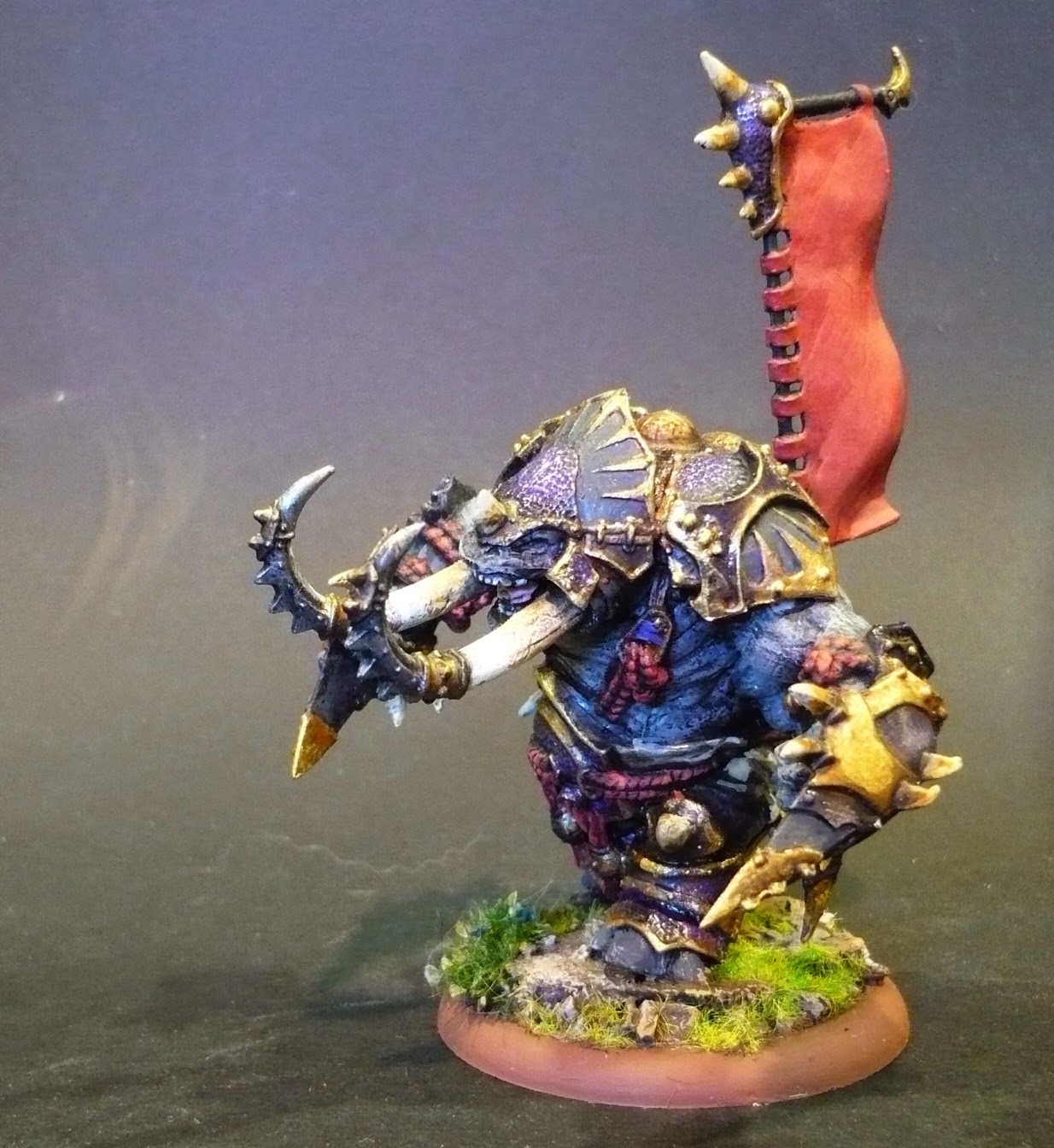
That should keep me well occupied for the winter! I've set a goal of 750 points, which I think should cover what I want to paint. I was too lazy to count every single figure and vehicle, so I just eyeballed. If you want to get in on the action, head over to this post and leave a comment. The only entry fee is to paint a figure to match the theme of the year and send it to Curt, the event organizer, before the close of the contest. This year's theme is "Anti-Heroes, Rogues and Ruffians" and I wasn't really sure what I was going to paint until, quite by accident, I just happened to run across this figure yesterday:


To which I can only say...

Oh...yeah...

Monday, November 10, 2014

Malifaux: First Encounters, First Impressions

Oof, nearly two months without a post. That's apt to change over the coming months, as I have finally taken the plunge and signed up for the annual Analogue Hobbies Painting Challenge. My hope is that by the conclusion of the contest in March, my current unpainted collections will all be painted up, and I'll be sure to share my progress along the way.

I've been priming my painting pump (not to mention sharpening my terraining scythe) of late by working towards a grand goal for this holiday weekend: hosting a bunch of Malifaux games! Two of my oldest and dearest friends were flying in, and grand plans were laid out to take the plunge into this new game. (We played many a game of Necromunda and Mordheim back in the day, and Malifaux seemed to scratch a very similar itch.)

The friends showed up Thursday night and we got to playing on Friday. Here, then, are some pictures from our many games (we each played three - two two-player scenarios a piece, plus an "all in" three-player scenario), followed by my thoughts on the game in general, and what I would recommend to new players like myself.

The board setup from our first game. Terrain consisted of Dave Graffam paper buildings and Zuzzy "Wounded City" rubber mat, with the 4x4 table marked off to the 3x3 area required by the game.

Another game's setup - the second session, I believe. Malifaux takes place in a sort of alternate steampunk history, so I decided to pick up a set of train tracks to add to the table. I'll be dirtying them up for future games.

My crew are from the Outsiders faction and consist of "the Viktorias" - a mercenary and her extra-dimenstional doppelganger who became like sisters. That's one great thing about the Malifaux setting, the many different colorful characters populating it that you get to play with.

This hellish contraption is called a "Peacekeeper" - ha! Seriously bad news, but Taelor (there in the foreground) stood toe-to-toe with it for several rounds before succumbing. The Viktorias got their revenge, though...

The Peacekeeper eventually fell to a coordinated attack, and I managed to pull a draw in my first game - although it would've been a loss had my opponent not neglected one of his Schemes (another fun aspect of the game).

This shot is from the three-way game, in which C. Hoffman's constructs duked it out with a local Gremlin tribe while my Outcasts snuck in and made off with the treasure. I love playing mercenaries!

A shot from the last game I played, Outcasts versus Gremlins. We found that each game had a distinctly different flavor, with some being very much about careful positioning and others devolving pretty quickly into out-and-out slugfests. Each faction definitely has some very carefully balanced strengths and weaknesses, and part of the fun of the game is discovering your own as well as your opponent's.

Leaving off with a nice little cinematic shot: my Student of Conflict facing down a Guild Hunter. One of the Viktorias bounded in and got her to safety on the next turn, if memory serves.

So what's the final verdict?

We loved Malifaux! I've got a second crew on the painting table already (Perdita Ortega and family), and hope to use it and my original crew to demo games for folks in my own community; my friends are likewise going to carry the gospel back to their town. I'm also planning some new terrain projects, both in terms of expanding my "urban" set-up that we used in this weekend's games as well as creating some new boards (the Latigo clan will need some arid land and adobe buildings to defend, after all).

Because of our Necromunda/Mordheim backgrounds, we dove in with the Campaign rules as presented in Volume 5 of Wyrd Chronicles from the get-go, and those proved very successful. I almost lost my leader, Viktoria of Ashes, after one game, but successfully pulled off a "deal with the devil" that earned her Black Blood (think the creatures' acidic blood in Aliens) and Flight. Triumph! As it was, I came out ahead on Campaign points (yet somehow last in total Soulstone value), and very satisfied with my crew - although I am going to go with the alternate sculpts for the Viktorias and third-party proxy for Taelor that I like better than the sculpts I have.

Game play proved deep and satisfying without getting too bogged down in mechanics (once we got over the initial learning curve, of course), and rules questions were few and far between and easily resolved (the index never failed!). The card mechanic was lot of fun and definitely provided an interesting and engrossing alternative to dice rolling.

Did we have any criticisms? Sure. Few to none of our beefs were with the game proper, however. Rather, there was some frustration with the game's product support.

See, Malifaux is currently in its Second Edition, and is still rolling out new product. The switch to 2E has also seen a switch to finely-detailed plastic kits replacing the old metal sculpts. So there are a lot of the old packs still floating around. And because the game uses stat cards to track models during the game, you can run into the problem of getting a set with old cards, like my friend Alex did with his Gremlins.

Fortunately, I had purchased the full rulebook, which includes copies of stat cards for all the major models in release at the time of publishing. There is, however, a truncated "table reference" volume that lacks those stats - if I had bought that book, we would've been SOL! Furthermore, my friend Tim and I had both bought some supplementary card decks feeling they were somewhat peripheral, only to find out that they were tremendously useful!

So if you're looking to get into Malifaux, here's the "boxed set" assortment I would recommend picking up to make sure your bases are covered:

Malifaux 2E Rules Manual

Two copies of the Strategies & Schemes Deck 

  • (This was invaluable, not just for remembering Victory Point objectives, but also because it came with a handy Quick Refernce card!)

Two "2E" boxed sets of your choice - the buy-in cost for this game is so low compared to 40K or WarmaHordes, it's quite easy to put together two or more crews

A set of dry erase pens to mark your cards - they're laminated, and have spaces to track wounds for this very purpose

ETA: Bah, I knew I was forgetting something--counters! This, in my opinion, is where the game could really use a boxed set in the GW mold, as it makes use of quite a few counters over the course of play but doesn't actually provide any. Fortunately, I had some proxy counters on hand for our weekend, but I'm looking at some third-party sources for the "real deal" and I'm liking what Counter Attack is offering. The "condition quadrant" markers in particular are quite swanky.

Optional

Two Fate decks

  • (You can use a standard poker deck to play, but the Fate decks looked nice and already had suits and card values converted, saving a bit of mental math during the heat of battle.) 

Arsenal deck(s) (example)

  • (These are decks for each faction that provide 2E stat cards for every model in the faction; there are currently two "waves" of releases, so make sure you get both to cover all your bases. If you're buying the latest kits, you probably don't need these, but if you're using older models that came with 1E or 1.5E cards, this purchase is mandatory.)

Tuesday, September 16, 2014

Female Gamers Go Back a Ways

[Since this has something to do with RPGs and something to do with miniatures gaming, I'm cross-posting it to both my gaming blogs.]

I've been slowly making my way through Jon Peterson's magnificent Playing at the World, a deep and scholarly (yet readable) account of the origins of role-playing games that goes all the way back to 18th-century chess variants and the emergence of genre literature and then traces things up through to the publication of the original boxed set of Dungeons & Dragons. It's a gaming nerd's dream, frankly.

One thing I've been taking away from my readings so far (I'm about halfway through) is that the more things change, the more they stay the same. Back during the whole "Consultancygate" brouhaha in July, for example, I just happened to be reading a section that touched on some of the infighting in the nascent gaming community following the publication of D&D, wherein two camps emerged, divided between the old guard wargamers and the more counterculture-inspired RPGers, both of whom claimed the other was "doing it wrong" and that they themselves had the moral high ground. It was certainly illustrative of the fact that the gaming community has always been subject to passionate debates on perceptions of who or what should and shouldn't be allowed in the hobby. 

More recently, of course, there's been a much more widely-reported controversy surrounding the acceptance (or lack thereof) of women in the larger video-gaming community. I'm not a video gamer by any stretch of the imagination, but over the years I've witnessed similar prejudices being expressed in the RPG hobby as well. Once again, Playing at the World has provided an interesting and timely point-of-view.

In my latest reading, the book is discussing a game called Fletcher Pratt's Naval War Game. Published in 1943, the game was developed from soirees Pratt (a pulp fiction writer) would hold at his Manhattan apartment (and later, when attendance got up to around 50 people, at a nearby hall) in which attendees would engage in a wargame featuring model ships, played out using the floor as the game space.

The game was significant to the later development of RPGs because it influenced the development of mechanics like Armor Class and Hit Points. But it was also significant for being the first time female gamers got a mention in a published wargame, previously perceived as the exclusive domain of men. Quoted from the rulebook itself:
"[Once Pratt's group had embraced the system] the sweethearts-and-wives influence became manifest. One of the latter appeared as a spectator of what was originally intended to be a purely stag game. In the midst of the ensuing red-hot engagement she was discovered flat on her stomach, aiming the guns of a cruiser and muttering something like, 'I'll get the so-and-so this time.' From that date on there was no checking the rising tide of feminism. Today there are nearly as many players of one sex as of the other; and one of the feminine delegation has been praised by a naval officer as the most competent tactician of the group."

Playing at the World goes on to feature an illustration from the book in which "a skirted woman, alongside her male counterparts, is shown kneeling on the floor, angling a cardboard arrow to fire at her target."

It also discusses how this inclusion represented an evolution from H.G. Wells' Little Wars (1911), the first wargame marketed to casual gamers; although the book subtitles itself as a "game for boys from twelve years of age to one hundred and fifty and for that more intelligent sort of girl who likes boys' games and books", Wells also complains within the pages of his rules of being interrupted "by a great rustle and chattering of lady visitors" who "regarded the [game] with the empty disdain of their sex for all imaginative things."

In my 25-plus years of tabletop gaming, I've gamed with at least as many women as men. My current weekly face-to-face group is comprised of a majority of women, and has been all-woman (save for yours truly) at times in the past. I've also gamed with women who were flat-out denied the opportunity to join other groups because of their gender.

I've written about this before, but I just want to reiterate that, of the women I've gamed with, some have sucked at math and others have loved crunch; some have been totally story-oriented and others have been violent and bloodthirsty. In other words, they've been just like all the male gamers I've played with.

I wanted to post this little piece of history simply because it shows that women's interest in the tradition of gaming from which RPGs, wargaming, and video games grew out of goes back a long ways. If this sort of history was better-known...well, we'd still probably have lots of stupid trolls out there spewing misogyny in-person and online, but knowing about stuff like this puts their ridiculous appeals to the "tradition" of an all-male hobby in an even weaker light, I think.

Sunday, September 07, 2014

Some Sunday Skorne

I've decided to set Paint Table Saturday aside - not that I don't enjoy seeing other folks' PTS posts, but old habits die hard, and I'm finding that I prefer to share photos of my finished minis in preference to WIP shots.

And hey, whaddya know? I've got some finished minis to share!

Since the beginning of the year, I've been slowly but surely putting together a collection of Skorne for Warmachine/Hordes. I've got a decent-sized force collected now, and the first models are rolling out of the old painting factory and (hopefully) onto nearby battlefields.

(Or rather, they will be once I finish up just a couple more models...)

In the meantime, here's what I've got finished so far:


From left to right, that's Dominar Rasheth, a Titan Gladiator, a unit of Paingivers, and a Paingiver Taskmaster.

In case it wasn't blindingly obvious from that description, the Skorne are all about inflicting pain as a means to power. These guys are wickedly, cartoonishly villainous, which is my kind of evil. Let's take a look at the individual units, then...


So this is the original Lord Humongous, a regular Hedonismbot if you will. It was this model that inspired me to go with the Skorne over a couple other factions I was considering. He's so wonderfully decadent. Plus, he stands in stark opposition to all the other Skorne leaders, who are nauseatingly physically fit. I feel that Dominar Rasheth is an icon that I, as an American, can fully get behind.


Plus the model is just all kinds of awesome, with tons of fun little details. I'm really pleased with how the Agonizers bearing his litter turned out. They look completely fed up.

Sadly, my decision to paint up my Skorne as albinos resulted in Dominar's abundant flesh getting a bit washed out. I'll have to fiddle with my camera settings for future photoshoots.


The Titan Gladiator was the other model that really attracted me to the Skorne. This model was a joy to paint, and I probably spent way more time on it than I should have. As you can see, on both the Titan and Dominar, I went with a non-standard color palette for the armor. My Legio Metalica titans are red and gold, and I wanted something a little different on my shelves. I decided to go with a lacquered armor with a purple cast.


I haven't decided yet if I'm going to just stick with the monochrome banner or put a design on it. We'll see how the other banners in my force shake out.

Finally, we've got my unit of Paingivers. For these, I went with a more standard Skorne color palette, although in my faction this palette is more like the guild colors for the Paingivers and not the sort of more general "Skorne uniform," if you will.


So that's that. As I mentioned, I've got a couple Cyclops Savages to finish up and then I should have a gamable force. With more to come after that!


Sunday, August 24, 2014

[Pendragon] Diorama-rama

I'm currently running The Great Pendragon Campaign for one of my tabletop RPG groups (which you can listen to here, if you're so inclined as to listen to RPG actual-plays). For those of you not in the know, this is an epic campaign for the King Arthur Pendragon game that takes players from the rule of Uther all the way through to the death of Arthur.

Part of the conceit of the game's framework is that as you move through the Arthurian saga, you move through the history of the Middle Ages. When you start out, technology and social mores are equivalent to the time of William the Conqueror; by the end, everyone's running around in Gothic armor and there's chivalry and chaste amor and all that stuff.

The campaign is divided up into Phases, and with the advent of a new Phase generally comes a shift in technology and fashion. The Great Pendragon Campaign features little vignettes at the beginning of each chapter showing a typical knight, squire, and lady of the Phase. As this venture represents a significant investment of time on my part, I decided to do the thing properly and take that vignette idea and turn it into little three-dimensional dioramas.

At present, I've so far made two dioramas: one for the Uther/Anarchy Phase, and one for the Boy King Phase. There are four more remaining to be made, and I'll post them on this blog as they come along.

First up, then, is the Uther/Anarchy diorama. These phases are not only evocative of the Norman period, but also feature some elements of the historical late-5th/early-6th century time that the phases nominally take place in, so I had fun researching Dark Age fabric dyes and colors. This is a time of pugnacious knights, Saxon invaders, and high social mobility.


Next up is the Boy King Phase. As the name implies, this is the period of King Arthur's appearance and  subsequent consolidation of his rule, and this is when the Medieval gloss fully overtakes the Dark Age period. It reflects the time of Henry II in England and the appearance of concepts of chivalry and tournaments. Hand-painting those chekers was fun!


Related Posts Plugin for WordPress, Blogger...